A Cheater Learns a Lesson

A Cheater Learns a Lesson

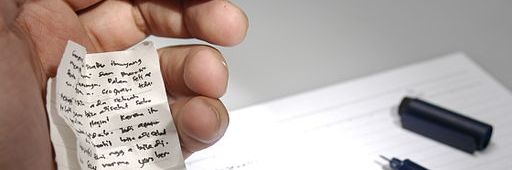
The first time I failed at school I was over 30. Don’t get me wrong. I have failed at many things–relationships, do-it-yourself projects, exercise programs, baking–but I finished school and university with good marks, without doing much work.
So when I found myself in a new city (Vancouver) with no job and few prospects, going back to school seemed like a good idea. I enrolled in a community college program to become a court reporter, and started to fail almost immediately. Continue reading

What’s in It for Me?

What’s in It for Me?

Two people commented on my last post, about how working with Bernice got me started on marking for confidence.

First, Evelyn said that she thought many teachers would have seen Bernice as “resistant or difficult or careless or smartass.” I think most of those judgements are accurate.

She was resistant–she did not want me to “go over” her work with her; she wanted to keep herself out of a situation she had doubtless been in many times before, where a teacher pointed out where she had gone wrong and expected her to fix her errors. Continue reading

Bernice Shows the Way

Bernice Shows the Way

I remember the moment that I began to mark for confidence. It was Bernice who got me started.

The class was finishing up their writing, and putting it into the envelope that went upstairs to the secretary to be typed so that everyone could have a copy of everyone else’s stories. I tried to catch people as they finished up their work, to do a final proofread with them.

On that day, Bernice strode purposefully up to the envelope hanging behind me. Continue reading

The Poster Explained

The Poster Explained

Evelyn brought me up sharply with her comment on my last post. She wrote, “…Talk about intimidating! I’ve read it a number of times now and still have to work my way through it to get the meaning! What do you like about it?”

I don’t mind being brought up sharply. It makes me think—and write. Still, after two recent posts people have asked for clarification. Maybe I should learn something from this… Continue reading

Nascent Deftness

Nascent Deftness

I’ve had this poster up on my wall (and engraved in my mind) for years.   (Click here for a pdf.) It has inspired me and guided my teaching.

The words are from an article called “A brief summary of the best practices in teaching intended to challenge the professional development of all teachers,” by T. Drummond.  The design is mine.

Reaction and more explanation of why I like this poster. 

Refuse to Be Bored      (A Second Look)

Refuse to Be Bored (A Second Look)

English: A bored person

English: A bored person (Photo credit: Wikipedia)

Both Jenny and Evelyn commented on my last post, “Refuse to Be Bored” to the effect that the rule is easier to describe than to implement. I agree, because I know I found it difficult to learn to do.I’m writing this blog with the benefit of hindsight; and the rule about refusing to be bored, as I set it out in my post last week, did not come easy to me, nor did it fall into place all at once. I know that at first when students had the temerity to suggest that they didn’t want to do something, I got, as Jenny said, defensive. Continue reading

Refuse to be Bored

Refuse to be Bored

I don’t have many rules in my classroom, but the most important one is “Refuse to be bored.”

So when I say, on the first day of term, that the first rule is to refuse to be bored, students are surprised. For one thing, most adults going back to upgrade their skills expect to be bored. Their experience of school is one of large stretches of boredom, accompanied by more or less anxiety, and interspersed with flashes of panic. Why would my class be any different? Continue reading

Yahtzee

Yahtzee

We rarely know how far our work goes, but once I got a glimpse—

I was working with some parents on producing a manual of family math activities (Family Math Fun!). We met twice a week for 11 weeks.

Jeannie (not her real name) only came to the first session, where I showed the group how to play Yahtzee, and gave them all dice and score cards to take home. We played a few rounds so that everyone got familiar with the game.

As the project came to a close a few months later, I asked all the participants to come in for a final interview, and Jeannie was happy to come.

Since she had attended only one session, I did not expect her to have got much benefit from the group, but I simply asked my first question, “Has coming to this group made any changes in your life?” She answered with a decisive yes.

She said that she and her husband got along better, as did the kids. “We have better communication. I see my daughters helping each other with school math by using a ruler or calendar, explaining, not just giving the answer.”

I asked what had made the change. Continue reading

Respect, Resistance, and Reality

Respect, Resistance, and Reality

Slowly, over the years, because I was willing to learn, my students taught me a new set of three R’s—Respect, Resistance and Reality.

First, Respect. Respect for them, and for every decision they took, every choice they made. Respect for myself.

Second, Resistance. They come back to school, that place of previous failures and humiliation, because they want what they think I offer—the key to a better life. I offer them different ways of learning: group work; choice; meaningful work; I invite them to join the teaching team and make decisions about how and what they will learn. But they resist my best efforts to do things differently, because it is not what they expect, and it scares them. They refuse to risk going back again into that position of failure and humiliation. I need to acknowledge their resistance publicly, to honour it, and to work with it. I need to recognize my own resistance, too, because it gets in the way.

Third, Reality. My work is most successful when I listen to what is really going on. Speak the unspoken thoughts and feelings. Do reading and writing that is real, in the real world. Find an audience for the voice; find information in response to questions; say yes to every chance to move the literacy work into the community, and bring the community into the class.