
Mandated Students

Mandated Students

judge 2They come because they have to.

Any of these people may have mandated students to your adult education class: the judge or their parole officer; their lawyer, hoping to make a good impression at a sentencing hearing; their social worker, financial aid worker, workers’ compensation officer, or other professional with the power to deny their request for benefits; parents who say if they want to live at home they have to go to school.

Unlike other students in your class, they are not self motivated; their motivation comes from someone outside the class, someone you have little influence on. Continue reading

How to Say “No!” to Your Teacher

How to say “No” to your teacher introduces students to a seven-step process for saying “No,” gives them some practice using prepared scripts based on common situations, and then assigns them the task of saying “No” to each other, and to me, at least once in the following week. (Detailed lesson plan, with scripts, here)

Seven Steps to Saying “No!”

The steps are surprisingly simple to articulate: Continue reading

Getting the Most out of Your Teacher

As August slips by, I’m reminded of activities that start the new year, which I put under the heading of “How to manage your teacher,” an essential skill for every student, at whatever level.
One year I asked my department head, the inimitable Vicki Noonan, to help me with an experiment. I said I couldn’t give her any details, but would she come in and give a presentation to my adult literacy class Continue reading

Why Is Writing So Hard? Reason #756

It was Mary Ann’s turn to read her story to the group. She stood up, took a deep breath and started. “The bottle was my friend for a long time.”

She looked up and took in the group of about 10 students and me, all listening intently, and following along on our copies of her story.

“I’ve been in AA for 12 years, but before that…” her voice broke, and she stopped reading. Continue reading

800% Improvement

800% Improvement

At the end of the first week of class I did a round, asking people what surprised them about the first week.

Billy’s response was, “I’m surprised I’m still here. Usually I drop out of these things after the first morning.”

He didn’t come back on Monday, and I never saw him again.

So there you are. Billy, a veteran of starting many programs–back to school, life skills, job readiness–had attended eight sessions the first week, instead of dropping out after the first morning Continue reading

Standard English

Standard English

The question of standard English is a thorny one for those of us who work with adult learners, and you will hear many opinions about how we should teach students who come from communities who use non-standard English.

Standard English is the language spoken by people who have been educated in the mainstream system. That means it is the language invented by people who have power, who are wealthy and who are white. It is by definition not the language invented by our students.

Standard English is not “correct” in itself, and in fact is constantly changing. For example, it is now considered correct to sometimes split an infinitive, and in Canada most people manage to get through days, weeks, and even months, without using “whom.”

Incorrect, sloppy, and ugly Continue reading

To, Two and Too

To, Two and Too

When I’m looking for something to do on Monday, I don’t want to see something that says, “Teach ‘to,’ ‘too,’ and ‘two’ by examining meaning and pronunciation, and find kinesthetic and auditory hooks to help learners remember the spelling.” I want details, details, details. So I’ve written lots of details today.  

Here is a lesson I have taught many times, to help students understand and remember the spelling of “to,” “too,” and “two.”

These three are called homonyms in every book or app that I have seen, but in my part of the English-speaking world, they are not all pronounced the same way. “To” is usually shortened in speech to “t’ ”  a “t” sound and a very little “uh” or schwa sound after it.

I like this lesson because it’s a new take on an old topic, because students collect and analyze the data and come up with the rules instead of me giving them out, because it involves a fair amount of moving around and fun, because it involves exploring the language, and finally because it offers the students some physical and auditory hooks to remember these three words, in addition to the usual meaning-based distinctions. Continue reading

I’m Sorry…

I’m Sorry…

temperPete was in my class that term, a student who described himself with pride as a “recovering asshole.” Most days it seemed to me that he was enjoying being stuck in the recovering stage, and wasn’t doing very much to move towards finally being “recovered.”

Still, we jostled along. He participated in class activities, and I held him accountable for treating others with respect.

One day in class he made a remark about women that seemed particularly aimed at me, and I lost it. I dressed him up one side and down the other. I can’t remember what he said, or what I said, but I remember that he shut up really quickly, and the other students tried to look like they were somewhere else.

I went home feeling ashamed of myself. Continue reading

Reading on Your Feet

Reading on Your Feet

The other day I talked about Human Digits, and today I’ll talk about a similar kind of activity for reading class, a sequencing exercise taken off the page into the middle of the room.

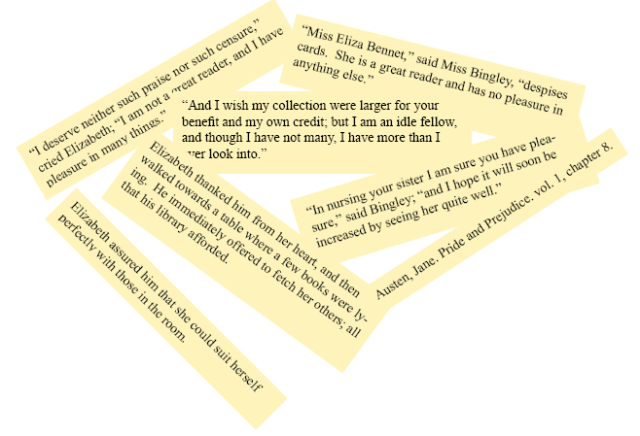
I often do this activity with groups of ABE instructors or literacy tutors; for them I choose a scene from Pride and Prejudice. I prepare by typing up the scene I have chosen, with lots of space between the paragraphs, and cut between the paragraphs. For every seven people in the session I’m planning, I need one set of paragraphs (see picture).

I divide them into groups of seven, give them the paragraphs, face down, and ask each person to choose one. I ask them to hang on to their paragraph and never give it to anyone else, and never lay it on the table. Continue reading

Getting Out of My Own Way

Getting Out of My Own Way

Reading a book

Some moments just stick with you–the flash of insight that marks a big change. A pivotal moment.

I am teaching Level 2 reading, and have passed out an interesting article from the West Coast Reader. Like many mornings, like many teachers, I start by introducing some words from the story that I think people may have trouble with. I write one of the words on the board, and as a group we read it, talk about its meaning, its pronunciation, its relationship to other words we know–you know the drill.

Continue reading