I’m not a counsellor. What can I do?

I’m not a counsellor. What can I do?

student teacher relationships, adult literacy adult education Yesterday I talked about how hard it is to be a “caring ear” for all the students who need one, and I propose today to outline my strategy for supporting students without being overwhelmed by their needs. I wouldn’t say I’ve ever perfected this strategy, but practicing has helped keep me on a more even keel, and given me more choice about when I choose to be the caring ear. Continue reading

The Heart Connected to the Ear

The Heart Connected to the Ear

Armando Gutierrez is the author of  “You Don’t Know Me,” a piece which I re-blogged about the great difficulties overcome, the supreme effort that some GED students put forth in order to come to class. A couple of months ago he posted a comment where I had re-blogged his original story, that started me thinking. He asked two questions: Could you deal with some of the issues your GED students are facing each day? And if you were, would you not want a caring ear to listen to you? The simple answers are no, and yes. Continue reading

A Restless Student Settles

A Restless Student Settles

Ken was restless. His legs and feet moved under the table so much that the whole table shook. Other students complained about the noise and the shaking. Ken was an extreme case, but ABE/Adult literacy classes are full of students who cannot easily sit still, and whose restlessness interferes with the learning of others. Continue reading

Why Is Writing So Hard? Reason #10

Writing is hard because it takes you places in your heart that you have spent a lot of energy trying to avoid. It’s healing for the same reason.

 My Parents               by Caroline Canute
I was upset at Dr. S. for giving my late dad too many morphine. I wish he asked us first if anyone wanted to speak to him. The same thing happened with my mom. Why couldn’t they give us a chance to speak with our parents? Dr. P. could of asked if any family want to speak with their parent. My late dad struggled with cancer. My late mom had pneumonia.            Continue reading

Resistance Live

Resistance Live

Attending to Resistance: An Ethnographic Study of Resistance and Attendance in an Adult Basic Education Classroom. Every teacher who tries to change things in the classroom meets with resistance from students, from administration, and from his or her own internal voice. Unless dealt with, this resistance can sabotage the implementation of any new teaching strategy or curriculum.

I watched a group of 30 or 40 ABE and adult literacy instructors bring the full force of their resistance to a presentation Continue reading

Fractions on Your Feet

Fractions on Your Feet

When students can match 1/4 with 25% with .25, you know they have some understanding of the value of each.

When they go on to the much more difficult matching of 79/1000 with 7.9% and .079, you know their understanding has deepened.

When you ask for an explanation of their work and they don’t start and end with “Move the decimal to the left two spaces,” you know they are on to something!

https://katenonesuch.com/2012/10/11/walking-and-talking-math/

Here’s a social math activity that extends the skill practice exercises in the workbook and online. A fuller explanation and all materials needed can be found on page 92 here in Changing the Way We Teach Math. Continue reading

I Don’t Give Grades…

I Don’t Give Grades…

Early in the term, I hand back their first writing assignment. I’ve made comments on what is effective in their pieces. No one pays much attention to the comments.

Instead, I hear a chorus of questions: “What’s my mark?” “How come there’s no grade here.” “What did I get?”

“I don’t give grades for writing,” I say.

When asked why, I give the real reason: I value my time and effort. Continue reading

Matching Exercises: Off the Page

Matching Exercises: Off the Page

If you’re a kid who can’t sit still, you get into a lot of trouble in elementary school. Kids like that often drop out, or fail to graduate with the classes and grades required for further training. To catch themselves up, they come back to adult literacy, ABE and GED programs, but they are still people who have a hard time sitting still!

Unfortunately for them, and for us who teach them, the cheapest and most readily available material for adult students often requires a lot of sitting still in front of a workbook of some kind or in front of a screen. Continue reading

We Value the Joy

We Value the Joy

teaching joyI once made an appointment with a counsellor provided by my employee benefit package for people having difficulties with situations at work. He asked me what was bothering me.

“I’ve lost the joy,” I said. He looked like he needed more from me, in order to understand my problem.

“I expect joy from my work,” I said, “And the joy has disappeared.”

He looked at me like I was crazy. I knew then that he wasn’t going to be any help, because he was used to people who wanted job satisfaction, but he thought it was really too much to ask for joy.

I knew I had right on my side, because it was there, in the statement of values our Department had written:

“We value the joy that comes from our work with students.”

The paragraph beginning “We value the joy…” means that we expect joy. We work to make it possible. We recognize it when it appears. We cherish it.

Katherine Gotthardt, who has made many thoughtful comments on this blog, talks about “teaching highs” and I know what she means. That’s part of the joy!

Sylvia Ashton-Warner

Sylvia Ashton-Warner

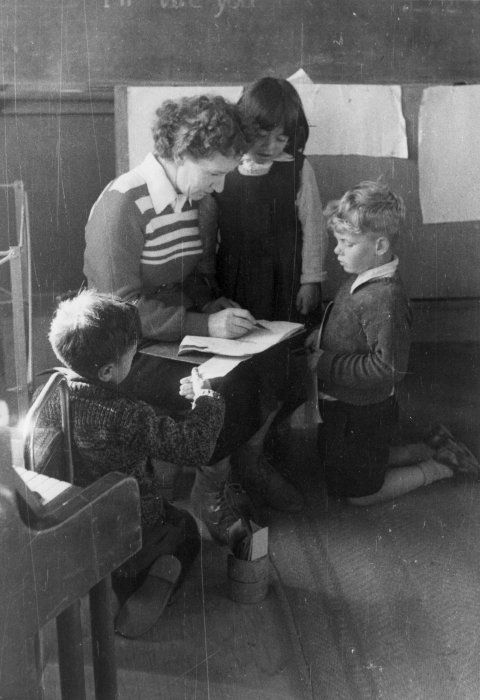
Sylvia Ashton-Warner with children in classroom, ca 1951 Reference Number: PAColl-2522-2-001

Sylvia Ashton-Warner with children in classroom, ca 1951
Reference Number: PAColl-2522-2-001

I have roots in New Zealand. Not physical roots—none of my ancestors came from New Zealand, or, as far as I know, ever visited there. But the roots of my ideas about teaching came from Sylvia Ashton-Warner, whose book Teacher I read in the mid ’60’s. She has been the single most important influence on my teaching practice.

She wrote about teaching pre-school and primary school children, and as far as I know never taught adult literacy or wrote about helping adults improve their literacy skills. But her ideas about creativity, what she called “organic teaching,” her respect for and celebration of the ideas that came from her students, not from curriculum and received texts, all of which went along with solid practical advice about classroom management, schedules, and “discipline,” spoke to me when I was in training to become an elementary school teacher, and came back to me when, much later, I started in adult literacy. Continue reading