Re: Where is the Teacher?

Re: Where is the Teacher?

I got an e-mail from Dave, who attended my workshop last week on “Putting Learners in the Driver’s Seat.” He asked, “If the learner is in the driver’s seat, where is the teacher?” I’m going to answer by telling the story of Lucie’s success at speaking in public.

Lucie won the class lottery! She got to come with me to Edmonton to present the Never Fail Writing Method that we used in our basic literacy program. A plane trip, three nights in a hotel, and a glimpse of the big city, Continue reading

Trust Your Ears

proofreading in adult literacyJanice Airhart commented on my post about The Period and the Sentence that it is best to ask students to proofread out loud.

So I thought I’d dig out a little poster I used to remind students about how to proofread.  (“Proofread out loud. You get a message from your ears and a message from your eyes. Trust your ears to catch the message you want to write.”) Continue reading

Building Strong Relationships with Learners

Building Strong Relationships with Learners

For the past week or so, I’ve been writing about five strategies for developing stronger rteaching adult literacy elationships with learners:

All five strategies are written up in one article published in the ELMO Review. (Click on the image.)

Any thoughts on these strategies as a whole? What’s your most useful strategy or habit for building strong relationships with adult learners?

Refuse to Give Advice

Refuse to Give Advice

giving advice adult education If you’re trying to have a more equal relationship with students, refusing to give advice is the best policy. Here’s my advice about giving advice to adult literacy, adult basic education or GED learners.

Watch the video, from Literacy Nova Scotia’s collection of videos called The Teaching Toolbox.

This is the last of five strategies for developing stronger relationships with learners. See also “Listen,” “Yes Means Yes,” “Make Your Teaching Transparent,” and “Say How You Feel.”

teaching adult literacy (You will find all five written up here.)

Say How You Feel

Say How You Feel

Like most of us I can’t hide my feelings. They show on my face, or in the set of my shoulders, or the sweaty palm prints I leave on the desk or table. Most students (like anybody else) will assume that my feelings have something to do with them. Here’s an example:

I’m in the middle of teaching and the student asks me to explain something again. (He still doesn’t get it after the third time.) I’m about to start the explanation when I notice the clock and suddenly remember that I have to cut this session short for an emergency meeting about a crisis in the program.

All my feelings about the meeting come over me–worry, wonder, anger, confusion, etc. These feelings show on my face or in my body–tight lips, far-away look, and hunched shoulders. Continue reading

Make Your Teaching Transparent

Make Your Teaching Transparent

photo: Nicholas Risch

Much of our work is invisible to adult learners in literacy, Basic Education or GED programs. At worst, they see us as people who know everything and get paid well for showing up for short days and short years and bossing them around.

At best, they think we’re wonderful people who have all the answers and are helpful and patient and don’t do anything between sessions with them. Continue reading

Yes Means Yes. No Means No.

Yes Means Yes. No Means No.

“I’ve been writing poetry since I was 13, and I’ve got a big binder with all my poems in it. Would you mark them for me?”

Over the years, those were the two sentences I most hated to hear from a student. I dreaded reading the poems, because I expected them to be really bad poetry, and depressing. I was always right on both counts. Continue reading

Listen, Really Listen

active listeningThere is no better way to show respect to a student than to listen. If you listen, learners will teach you how to teach them.

If you listen, you’ll be surprised. And when you’re surprised, you’re not bored. That’s a good thing if you’ve been doing this job for a long time. Continue reading

The Period and the Sentence

How do you know where to put the period? Use your brain. Use your ears. Use your whole body.
The period is near the top of the list of mechanical things to teach when you’re working with beginning writers. But However, it’s hard for students to grasp the idea of putting a period “at the end of a sentence” when they don’t have much of a grasp of what a sentence is.

Language Experience Approach

If I’m using LEA, I’m secretly glad that I get to teach periods from the start, Continue reading

A Teacher Hits the Target

A Teacher Hits the Target

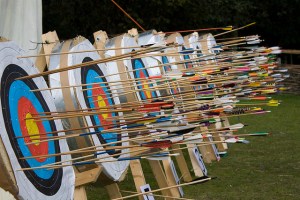
I learned a lot about how to give learning a physical component from the late Christina Patterson. I had always been good at using manipulatives, getting people moving and so on, but Christina pushed physicality to a new level for me.

One year, near the beginning of term, she took a whole class to the local archery club for a morning of lessons from the club pro, followed by lunch.

When they all got back to the classroom, Christina got the discussion started with “What did you learn about hitting a target?” and made a list as students talked. Continue reading